August 3, 2026
Dropshipping in 2026: Real Alternatives That Still Work
Dropshipping in 2026 is harder than the ads suggest. What actually changed, the real margin math, and the models beginners should look at instead.

Open any social feed and the pitch is unchanged from 2019: no inventory, no upfront cost, pick a product, run ads, collect profit. The dropshipping model still exists. What changed is the arithmetic underneath it. This article covers what broke, the real margin math, and the dropshipping alternatives that hold up in August 2026.
The 2019 playbook went like this: find a trending product on AliExpress, list it in your own store, run Facebook ads, and let the supplier handle storage and shipping. You never touched the product. You never met the supplier. Dropshipping appeared to eliminate inventory risk and storage costs, which made it sound perfect for anyone with a laptop and a few hundred dollars.
By August 2026, that version rarely matches reality. The dropshipping market is large and still growing, and a meaningful share of ecommerce businesses use dropshipping as their primary model. The opportunity is real. But finding reliable suppliers is one of the most commonly cited challenges, supplier reliability issues can destroy your business reputation, and subpar product quality from suppliers directly affects customer satisfaction. Limited control over suppliers can lead to unexpected stock shortages, and dropshippers often face shipping delays due to unreliable suppliers.
What readers actually mean when they search for dropshipping alternatives is this: a way to start an ecommerce business with low initial costs, less inventory risk, and a realistic path to profit. The pressure points are specific. Ad costs climbed since 2022. Payment providers and ad platforms now penalize high refund rates. Customers trained by Amazon expect delivery in one to three days; a three-week shipping window reads as a red flag. This article reframes the question from "is dropshipping dead" to "which low-inventory models are actually worth it in 2026."
This is not a get-rich-quick guide. The angle is sober, numbers-first, and aimed at protecting your money and your months.
Dropshipping profitability is a math problem, not a mindset issue. Margin per order versus the real cost of getting and serving a customer determines whether a dropshipping store makes money or bleeds it.
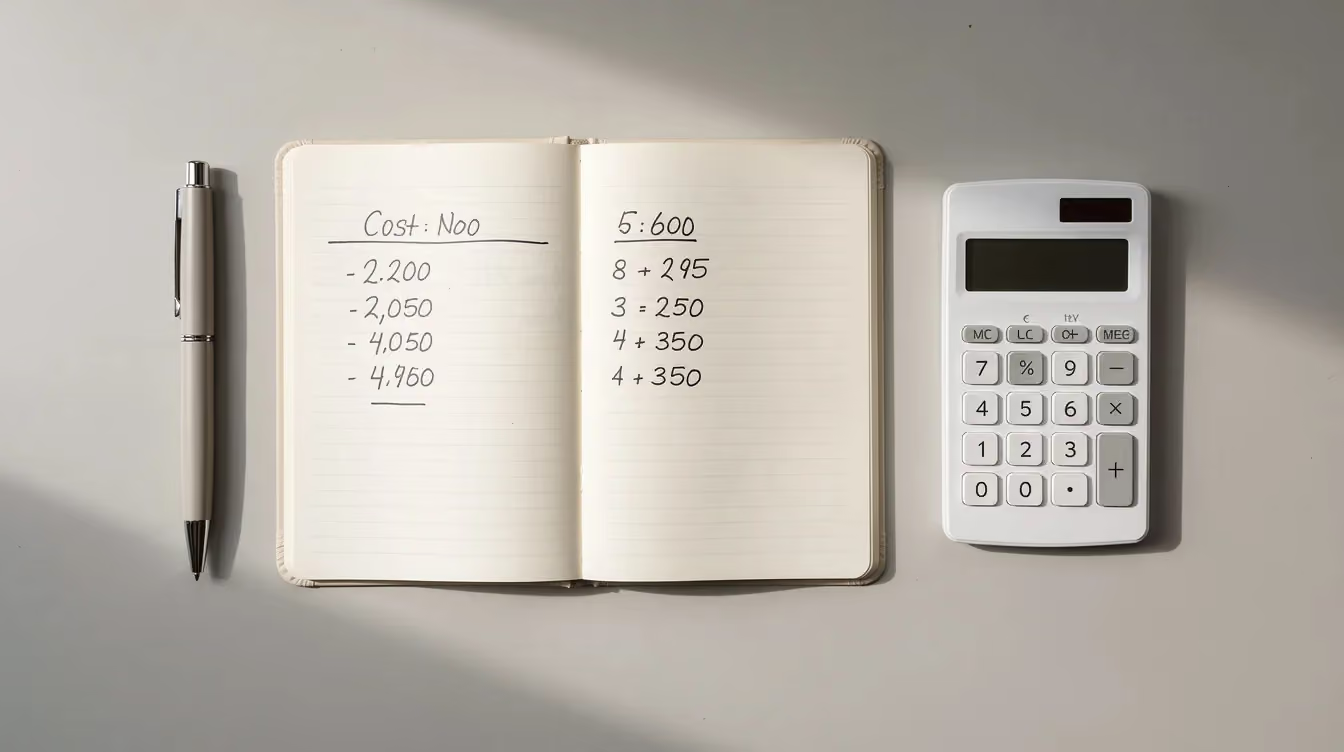
Here is a realistic worked example for a $40 retail price product in a beginner dropshipping business:
Cost item
Estimated range
Supplier cost + overseas shipping + duties
$10 to $15
Payment processing (~2.9% + $0.30)
$1.20 to $1.80
Customer acquisition cost (Meta/TikTok)
$20 to $45
Refunds, chargebacks, replacements (5-8%)
$2 to $3
Apps, platform fees, tools per order
$2 to $4
Add those up at the unfavorable end: roughly $65 to $70 in costs against $40 in revenue. You are losing money on every sale while your revenue graph goes up. Even at the favorable end, where costs land around $35, the net profit margin is only a few dollars per order.
Those two pictures are not in conflict — they describe different stages. The loss-making version is where most beginners start: low ticket price, paid traffic, no brand, no repeat customers. Stores that reach a healthy net margin get there by changing the inputs — higher ticket prices, cheaper traffic, repeat purchases — not by finding a better product on the same terms.
Net margins for a store that is actually working are healthier but still modest. Low-ticket products yield 5 to 15% net margins. High ticket dropshipping can achieve 20 to 45% net margins, which is why high ticket dropshipping focuses on premium items like tech accessories and specialized equipment. But most beginners sell low-ticket products, and most industry estimates put the failure rate for new dropshipping stores very high, though the figures vary widely by how failure is defined.
Dropshipping stores need a gross margin of 40 to 60% to be viable, and rising costs on every side make that harder.
Dropshipping requires significant effort in product research and marketing. The startup cost is low, typically $500 to $1,000, but that number buys fewer ad tests than it used to. This math is the reason experienced sellers look for dropshipping alternatives: not to avoid work, but to pick a model where the unit economics match their budget and skills.
Dropshipping is still worth exploring, but the lazy version is gone. Overseas, long-shipping, commodity-product dropshipping is now a fragile, thin-margin arbitrage game. Brand-led, niche-focused, faster-shipping variants still function as a real business.
The operators who still make dropshipping profitable in 2026 quietly shifted their approach: fewer products, better dropshipping suppliers, investment in brand building, and diversification into alternatives like private label and print on demand. Successful dropshippers build brand equity over generic reselling. Building a brand requires clear positioning and fast support, not just a Shopify theme and a trending product.
Many of the most successful "dropshippers" in 2026 technically run hybrid models. They use local warehouses for proven winners, branded packaging for customer satisfaction, and pre-buy inventory once demand is validated. These hybrid approaches overlap with the alternatives discussed below.
Wanting alternatives is rational. The economics genuinely changed compared to pre-2020. The question is which alternative fits you.
Every business model involves trade-offs between startup cost, control, and potential profitability. Before picking a model, evaluate it against a few criteria:
Choosing the right online retail method involves weighing factors like cost and control. Traditional inventory ecommerce requires upfront investment and managing logistics for stored products; dropshipping avoids that but gives up control. The alternatives below are structured around these criteria.

The model is the same as classic dropshipping in structure: you sell products in your own store, and the supplier handles storage and ships them. The difference is that your reliable suppliers are in the same country or region, enabling 2 to 7 day delivery instead of 2 to 4 weeks.
This changes several variables. Product costs are higher because you lose the overseas labor arbitrage, but refund rates drop, chargebacks fall, reviews improve, and repeat purchases become realistic. When a customer gets a package in four days instead of twenty-two, the entire post-purchase experience changes.
Finding local suppliers in 2026 means browsing B2B marketplaces, attending regional trade shows, and reaching out directly to small manufacturers or distributors in your niche. The key is picking a focused category you understand well enough to evaluate supplier quality without relying solely on research tools.
Initial costs include store setup, first samples, possibly small test batches for bestsellers, and a modest ad budget. This is still relatively low-risk compared with fully holding inventory in a warehouse.
Pros: better customer trust, simpler compliance, real brand potential, fewer shipping delays. Cons: thinner per-unit margins, more negotiation work, harder to find suppliers than clicking "import" on AliExpress.
This alternative suits people comfortable with communication and willing to establish reliable supplier relationships beyond a single overseas catalog. You spend money on better sourcing, not just more ads.
Print on demand is a fulfillment model where products are printed only after a customer places an order. Apparel, wall art, mugs, phone cases: each item is produced one by one, eliminating traditional inventory management entirely. Print on demand allows for custom designs and does not require holding inventory.
Comparing print on demand vs dropshipping directly: POD trades lower margins and production lead times for unique designs and stronger brand building. You avoid pure commodity competition because your designs are yours. Nobody else sells the identical product.
The economics in 2026 look like this. A POD T-shirt base cost might run $8 to $12, selling for $25 to $35 in Western markets. Gross margins sit around 60 to 65%, but once you deduct shipping, platform fees, ad costs, and refunds, net margins commonly drop to 15 to 35%. Heavier items like hoodies compress margins further. The global POD market is sizeable and growing quickly, with apparel making up a large share of it.
The main success levers: strong designs, deep understanding of a specific audience, organic channels like TikTok or Instagram to reduce reliance on paid advertising, and email lists to drive repeat purchases.
Risk is mostly time and creative effort, plus store setup and sample orders. Monetary risk is lower than private label, but failure risk is tied to design quality and audience fit.
POD is best for designers, creators, brands with existing followings, or anyone willing to invest in aesthetics and storytelling rather than product arbitrage. If you can create custom products people want to wear or display, the model works.
Private labeling involves manufacturing a generic product and rebranding it under the entrepreneur's own name. This is the "grown-up" evolution of many successful dropshipping businesses: you buy in bulk from a manufacturer, customize the product with your logo, packaging, or small improvements, and sell products under your own brand through your own store or marketplaces.
Private labeling allows for high profit margins because branding enables premium pricing. You gain direct control over quality products, packaging, and the customer experience. You build an asset that has resale value.
Concrete numbers for 2026: a first order of 200 to 500 units, combined with freight, basic branding, and photography, typically costs $2,000 to $5,000 for a lean launch or $5,000 to $15,000 for a mid-range one. Target gross margins in private label range from 30 to 60% or higher depending on category.
The workflow for many sellers starts with validating demand through small-scale dropshipping or preorders, then transitioning to private label once a product proves it can sell.
Pros: higher profit margins, strong brand equity, defensible niche positioning, potential to sell the business later. Cons: inventory risk (cash tied up in unsold inventory if forecasting fails), need for more serious operations like inventory management, fulfillment decisions, and possibly third party suppliers or 3PL warehouses. Stock shortages from bad forecasting can hurt as much as overstocking.
This model fits readers who can commit more capital, who think beyond quick cash, and who want defensible positioning in their niche over several years.
Digital products are a radical dropshipping alternative. Nothing physical ships. There is no inventory management, no shipping delays, and margins can be extremely high once the product exists. Digital products can be sold an unlimited number of times at near-zero cost per sale.
Common forms in 2026: downloadable templates, niche e-books, online courses, cohort-based programs, membership sites, and service-based businesses that can turn personal skills into streamlined online agencies offering fixed-price services. You still market, sell, and deliver value online, but the cost structure is fundamentally different from the traditional dropshipping model.
Initial costs are low: tools to host content, maybe basic recording gear or design software, but no bulk product purchases. The main investment is expertise and content creation time. Platform costs for hosting a course or selling a download are minimal compared to running an online store with physical products.
The limitations are real. Digital products require demonstrable knowledge. Competition can be intense in broad topics. Trust-building through testimonials, samples, and audience-building matters even more than in physical ecommerce. Inconsistent product quality here means poorly structured content, which kills customer satisfaction just as fast as a low quality physical product.
This alternative suits readers who already have skills others want to pay for. If you are weighing this against physical products, the ecommerce vs digital products comparison covers the strategic choice in depth.
Marketplace arbitrage means sourcing discounted or underpriced items locally (clearance racks, outlet stores, small wholesalers) and reselling them on platforms like Amazon, eBay, or niche marketplaces.
This is not traditional dropshipping because you usually hold a small amount of inventory. But it shares the low-barrier, low-commitment spirit people look for when they search for dropshipping alternatives. Items are often shipped directly to the buyer from your home or a small storage space.
The model benefits from existing marketplace traffic, reducing dependence on paid advertising while requiring solid product research and understanding of fees. You can test products quickly and get fast feedback loops on what sells.
Main costs: initial stock purchases (often a few hundred to a few thousand dollars), marketplace fees, shipping supplies, and time spent sourcing and listing.
Pros: fast feedback, lower marketing spend, ability to learn ecommerce fundamentals hands-on. Cons: minimal brand building, dependence on marketplace rules, difficulty creating long-term differentiation, and potential profit margins are capped by competitive pricing and platform fees.
This is a good starting model if you want to learn how an online business works in practice before committing to a full branded site or private label play.
Subscription boxes are a hybrid alternative: you curate products from multiple suppliers (sometimes dropshipped to you in bulk), assemble them into themed boxes, and ship them monthly or quarterly under your brand. Subscription businesses offer predictable monthly revenue and higher customer lifetime value.
This model can outperform classic dropshipping profitability because recurring revenue is more predictable, customer loyalty compounds over time, and you can negotiate better wholesale rates as order volumes grow.
Examples relevant to 2026: wellness boxes, niche hobby kits, eco-friendly household products, or digital-plus-physical bundles where a course access code ships alongside a physical starter kit.
Initial costs include product purchases for the first batch, packaging design, fulfillment logistics (often handled from home in early stages), and customer support for recurring orders. Handling customer inquiries on subscriptions takes more effort than one-time sales.
While this alternative requires more hands-on inventory management than pure dropshipping, it creates higher customer lifetime value. That helps offset rising ad costs and makes your marketing strategy more sustainable over time.
This path fits readers who like curation, storytelling, and community-building, and who are comfortable with more operational work in exchange for better economics and stronger customer loyalty.
Service-backed ecommerce means selling a physical or digital "starter product" that leads into a higher-ticket service: setup, customization, consulting, or training.
Concrete examples: offering a DIY website template with an upsell for done-for-you installation. Selling specialized equipment with paid setup and training sessions. Offering a design file with an optional custom revision package.
The initial product may have thin margins similar to classic dropshipping, but the attached service increases average order value and overall dropshipping profitability. A $30 product with a $200 service upsell changes the math entirely.
Requirements: domain expertise, capacity to deliver services, systems for scheduling and client communication, and a basic ecommerce storefront. The marketing strategy shifts from volume-based advertising to trust-based content and demonstrations.
This is a strong alternative for readers with existing professional skills who are tempted by dropshipping only because of the "online" part, but who could earn more by combining products with services in their own store.
Rather than picking the model with the best story, work backward from what you actually have. Here is a simple framework based on three inputs: budget, skill strengths, and time horizon.
Budget under $500: print on demand products or digital products with organic traffic and small ad tests. Marketplace arbitrage also fits if you can source locally. At this level, avoid any model requiring bulk inventory; the risk of losing money before learning the basics is too high.
Budget $500 to $2,000: local supplier dropshipping in a narrow niche, marketplace arbitrage with a larger initial stock, or a lean subscription box MVP with a small first batch. You have enough to test products with modest ad spend.
Budget $2,000 to $5,000 or more: private label, mixed subscription plus service-backed offers, or a serious POD brand with paid traffic behind it. At this level you can afford real product development and higher quality products.
Common reader goals map to specific models:
Switching between models every few weeks is one of the biggest killers of progress. Pick one alternative and commit to a 6 to 12 month learning window. The transferable skills (marketing, analytics, customer experience) will carry over if you later pivot to another ecommerce business. For a broader view, the online business models for 2026 overview covers the full landscape with the same trade-off framing.

Six errors show up repeatedly when beginners try dropshipping alternatives:
Five skills carry across every dropshipping alternative:
Financial literacy. Knowing your margins, break-even ad costs, and cash flow protects you from the most expensive mistakes. If you cannot calculate your average profit margin per order, you cannot tell whether your business is working.
Persuasive product pages. Whether you sell physical or digital products, the page that describes the offer determines conversion. Good copy closes the gap between ad spend and revenue.
Basic content creation. Organic traffic from TikTok, Instagram, YouTube, or a blog reduces dependence on paid ads. This matters more in 2026 than it did in 2019, because ad costs continue rising.
Customer empathy and communication. Handling customer inquiries promptly, setting accurate expectations on shipping or access, and turning problems into trust-building opportunities. This is the foundation of repeat purchases and customer satisfaction.
Simple repeatable processes. An operator who can build a checklist for order fulfillment, returns, and weekly reporting will outperform one chasing the next automation tool. Learning platforms matter less than understanding principles; someone comfortable with analytics and customer feedback can switch between Shopify, marketplaces, or course platforms easily.
Invest your first serious effort into these transferable skills before chasing advanced automation or complex funnels. The ecommerce learning path sets out a sequence that avoids the usual overwhelm. The skills that actually pay in 2026 covers where the real leverage sits now.
When you are ready for automation, AI for ecommerce explains where it applies, and AI automation coaching offers hands-on support.
Classic overseas, low-ticket dropshipping is fragile in 2026. Several low-inventory alternatives offer healthier economics and more control. None of them removes the need for work, but the right model matches your budget, skills, and appetite for brand building in a way the generic dropshipping business pitch in ads never could.
No model guarantees success. But picking one alternative, defining a realistic testing budget and time frame, and treating the first months as deliberate learning rather than a pass/fail test reduces the chance of wasting both money and time. Dropshipping is still worth understanding; it just is not the only path, and for most beginners in 2026, it is not the best one.
Ecommerce will keep evolving beyond 2026. The skills in numbers, customer understanding, and consistent execution will remain valuable across whatever models come next. If you want a structured path rather than another list of tactics, the Webgru Academy covers the fundamentals in one sequence. You can also read Marko's background or get in touch if you would rather talk it through first.
Paid advertising is helpful but not mandatory. Models like POD, digital products, and subscription boxes can launch through organic channels: TikTok, Instagram, YouTube, or email lists. Relying purely on organic traffic usually means slower growth but lower risk, which may be ideal if initial costs must stay under a strict limit.
A blended marketing strategy for 2026: start with organic content to validate offers, then reinvest early profits into modest ad testing. This avoids committing heavy ad spend before you know whether the product resonates. Many dropshipping alternatives work better with organic traffic than classic dropshipping ever did, because unique products and brand stories give you something worth sharing.
Marketplace arbitrage and simple POD designs fit limited hours more easily than private label or subscription boxes, which require larger operational blocks. You can source products on a weekend, list them in an evening, and handle customer inquiries asynchronously.
Digital products also suit part-time creators if you batch production on weekends and automate delivery. Prioritize models with fewer moving parts: no complex fulfillment, fewer suppliers, and a marketing strategy that does not require daily attention. Set a realistic weekly time budget before committing to any model.
Simple ranges: under $500 for lean POD or digital product MVPs with mostly organic traffic. $500 to $1,500 for local supplier dropshipping or marketplace arbitrage. $2,000 to $5,000 or more for a serious first private-label run.
These figures include both setup (platform costs, samples, basic branding) and a reasonable testing budget for traffic or initial stock, not just the first supplier invoice. Decide in advance on a maximum amount you are willing to spend in the first three to six months so you can stop or pivot before overspending. Treat it as tuition, not a guarantee of profit.
Many experienced sellers run hybrids. A common path: start with classic dropshipping to validate demand, then shift winners into private label or local supplier fulfillment once you can guarantee product quality. Some layer services on top of physical products, or expand a POD line into a fuller merchandise brand.
Beginners should avoid juggling too many models at once. Focus on one primary model and use others only as clear next steps. Spreading limited time and money across multiple unproven models instead of building depth within one approach is a consistent pattern among stores that never reach profitability.
Skills developed while testing any ecommerce model in 2026 are transferable. Product research, copywriting, ad or content creation, analytics, and customer support all apply across models and industries.
Someone who fails with POD but learns TikTok content creation can later apply that skill to digital courses, client work, or private label brands. Someone who runs a failing dropshipping store but learns to read unit economics can make smarter decisions in any online business they try next. Treat each attempt as skill-building with compounding value, not a binary success or failure. There are parts of any operation that should stay manual even as you grow; what should never be automated covers where to draw that line.
Last updated: August 2026. Cost and margin figures in this article are illustrative ranges based on common beginner scenarios, not guarantees or research findings. Results depend on execution, niche, market and effort.
Unsere neuesten Nachrichten und Trendthemen
Lernen Sie E-Commerce mit Klarheit, Disziplin und echter Erfahrung.

.avif)
.avif)