June 26, 2026
What E-Commerce Tasks Should Never Be Automated? (The Limits of Automation)
AI can automate almost anything — but should it? Learn which ecommerce tasks to never fully automate, and a 5-question framework to know where to keep humans.


There is a strange irony in the world of e-commerce automation: the tasks that should never be automated are the ones that depend on human judgment, emotional context, trust, high-stakes financial calls, or signals that only come from real personal involvement. In those areas, automation should assist the team, not replace it.
The companies most eager to automate everything are often the ones who end up damaging their business the fastest. They automate refunds, and customers feel cheated. They automate complaints, and a small problem becomes a public one. They automate their brand voice, and the thing that made them special quietly disappears.
Meanwhile, the operators who scale most cleanly are the ones who treat automation with a kind of disciplined respect. They automate aggressively where it creates leverage — and they protect, fiercely, the handful of tasks where a human touch is the entire point.
This article is for e-commerce operators, founders, and business leaders in that second group. Because almost everyone writes about what you should automate. Far fewer talk honestly about what you should not. In an era where AI can technically automate almost anything, knowing where to stop has become one of the most valuable skills an operator can have.
Automation is leverage. But leverage applied to the wrong task does not save you time — it amplifies mistakes, weakens customer trust, erodes brand identity, and can do real financial damage. By the end of this article, you will have a clear framework for deciding what to automate, what to keep human, and how to handle sensitive work like customer support, financial decisions, brand voice, strategy, quality control, and key relationships without compromising the business you are trying to scale.

Before listing specific tasks, it helps to understand the single principle that governs all of them.
Automation is an amplifier. It takes whatever process you point it at and runs that process faster, more often, and at greater scale. If the process is sound, automation multiplies a good outcome. If the process involves nuance, judgment, or emotion that the automation cannot actually replicate, it multiplies a bad one — just as efficiently.
This is why the question is never simply "can this be automated?" Almost everything can be, technically. The real question is "what happens when this runs a thousand times without a human in the loop?" For some tasks, the answer is wonderful: a thousand instant order-status replies, a thousand correctly routed shipments, a thousand accurate inventory updates. For others, the answer is a slow-motion disaster: a thousand tone-deaf responses to upset customers, a thousand wrongly approved refunds, a thousand emails that sound like they were written by a machine because they were.
The tasks you should never fully automate share a common DNA. They involve human judgment, emotional context, high-stakes financial decisions, trust, or the irreplaceable signal you get from doing something yourself. Whenever a task carries one of those, automation should assist — never replace — the human. This is the same principle behind keeping a human in the loop for anything sensitive, and it is worth treating as a hard rule rather than a guideline.
With that lens in place, here are the specific areas where the rule applies most.
The fastest way to damage a brand is to let a machine handle a moment that demanded a human.
When a customer is upset, disappointed, grieving, or angry, they are not looking for an efficient response. They are looking to feel heard. An automated reply — however well-written — communicates the opposite. It tells the customer that their frustration was processed, not understood. And customers can feel the difference instantly.
This does not mean AI has no place in support. As covered in depth in the AI workflows for ecommerce customer support approach and the broader guide to AI workflows for e-commerce customer support, AI is excellent at the high-volume, low-emotion layer: order-status questions, shipping FAQs, returns policies, basic product queries. For complex inquiries, 80% of customers still prefer human agents. These should be automated, because speed genuinely improves the experience there.
But the emotional layer is different. Complaints, refund conflicts, product failures, and anything involving a customer who is clearly distressed should route to a human every time to protect the Customer Experience. The right model is not "automate support" — it is automate intake and routing, keep resolution human where emotion is present. Let AI classify, prioritize, and even draft a response, but let a person read the room and decide what actually gets sent.
The cost of getting this wrong is severe and asymmetric. A handled complaint can turn a frustrated customer into a loyal one. A mishandled, automated complaint can turn one bad experience into a public review, a social post, and lost trust that costs far more than the time you saved.
Some decisions are simply too consequential to leave to a rule running on autopilot.
Refund approvals are the clearest example. A refund is not just a transaction — it is a judgment call that balances customer fairness, fraud risk, policy, and relationship value. An automated system can apply the same rigid logic to a loyal five-year customer and a serial refund abuser, especially when biased customer data shapes the outcome. In some cases, automated tools have denied credit to women more than men. It cannot weigh context, read intent, or recognize when bending a rule builds loyalty and when enforcing it prevents loss.
The same applies to any task that moves significant money or carries real financial exposure: large supplier payments, high-value discounts, chargeback disputes, contract approvals, and bulk purchasing decisions. These are exactly the places where an automation error does not just waste time — it directly costs money, sometimes a lot of it, before anyone notices.
The principle here is firm: **never fully automate a decision whose mistakes are expensive and hard to reverse.**Automation can prepare these decisions — gather the data, flag the risk factors, draft the recommendation — but a human should hold the final approval. This "draft and review" model gives you most of the speed with none of the catastrophic downside. It is the single most important checkpoint to protect, and it is one of the most common AI implementation mistakes to skip it.
You can automate the production of content. You cannot automate the point of it.
This is one of the most tempting traps in modern e-commerce. AI can generate product descriptions, blog posts, emails, and social captions at infinite scale. So founders flip the switch and let the machine write everything — and within a few months, their brand sounds exactly like every other brand using the same tools. The distinct voice that made customers feel something is replaced by competent, forgettable, generic text.
The nuance matters here, because this is not an argument against using AI in content at all. Generative AI and AI tools are genuinely powerful drafting aids, not owners of brand identity. The right use is as an assistant that works within a voice you have defined: it expands your outlines, drafts first versions, handles repetitive formatting, and adapts your existing messaging across channels. What it should never do is originate your brand identity, your core positioning, your founder's point of view, or the strategic narrative that differentiates you.
The rule is: automate content production, never content identity — because true creativity is still a uniquely human advantage. The voice, the perspective, the strategic angle, and the editorial judgment about what is worth saying — these are the assets. The typing is the commodity. Confusing the two is how brands automate away the exact thing that made them worth following.
This connects directly to a broader truth about systems: a tool can produce output, but only a human can decide whether that output is right. Pointing AI at an undefined brand is just another version of automating confusion instead of clarity and creates the kind of ecommerce tool chaos that keeps businesses stuck.
No automation can run your business for you, and the moment you let it try, you stop being the operator.
Strategy is the work of weighing incomplete information, reading a market, sensing where things are heading, and making a bet. These are the decisions that define the business: which products to launch, which markets to enter, how to position against competitors, when to scale and when to hold, which opportunities to chase and which to ignore.
AI can be an extraordinary input to these decisions, helping with data analysis and surfacing key metrics that matter. It can summarize data, surface patterns, model scenarios, and challenge your thinking. The five core ecommerce systems — traffic, conversion, retention, operations, and analytics — all benefit from AI-assisted analysis, as outlined in the framework on the five core systems every e-commerce business needs before scaling, and modern platforms with ai driven analytics can support informed decisions and faster data driven decisions. But the decision itself is yours. AI optimizes within the goals you set; it cannot decide what the goals should be, because that requires values, risk appetite, vision, and accountability that no model possesses.
The danger is subtle. When you offload strategic thinking to a system, you do not just risk a bad decision — you slowly lose the operator's instinct that comes from making decisions and living with their consequences. That instinct is built, not downloaded, and it is one of the most valuable assets you own. Use automation to inform judgment in decision making, never to replace it.
There is a category of task whose entire value is that a human looked at it. Automating it defeats the purpose.
Quality control is the prime example. The point of a final check — on a product before it ships, on a page before it launches, on an order that looks unusual, on a campaign before it goes live — is to catch the thing the automated process missed, because automation can reduce errors in routine flow but still miss edge cases that need human judgment. If you automate the quality check itself, you have simply added another automated step that can miss the same thing. You have removed the one safeguard that was supposed to be different.
This is why even the most automated operations keep human "final eyes" on the things that matter most: spot-checking fulfillment quality, reviewing flagged orders, sampling AI-generated outputs before they reach customers, and sanity-checking anything that looks statistically strange. The human is not there to do repetitive tasks. Automation handles the manual work. The human is there to provide the judgment that catches the exception.
The principle: automate the process, but keep a human checkpoint where a missed error is costly or visible to customers. This is not inefficiency. It is the cheap insurance that prevents an automated mistake from scaling into a thousand identical ones, and it also helps reduce human errors caused by overtrusting an automated output.
Some relationships are too valuable to be handled by a system that treats everyone identically.
Your VIP customers, your top suppliers, your key partners, and your most engaged community members expect — and deserve — a human relationship. These are the people who drive a disproportionate share of your revenue, give you your best feedback, and advocate for your brand. For high-value accounts, that kind of customer relationship management cannot be reduced to an automated, templated touchpoint. It signals exactly the wrong thing to them: that despite their value, they are just another row in a database.
This does not mean automation has no role. It is perfectly fine to use automation to support these relationships — to remind you when a VIP hasn't ordered in a while, to surface a partner's recent activity, or to flag shifts in customer behavior that warrant outreach. That is automation serving the relationship. The mistake is letting automation be the relationship. The reminder can be automated; the personal message that follows should not.
The rule is simple: automate the trigger, personalize the touch. The few relationships that matter most are where your human attention generates the highest return, and over time that strengthens relationship management and improves customer value. Protect them from the efficiency that serves everywhere else.
You will not always have a pre-written rule for every task. New situations come up constantly, so what you really need is a way to decide on your own and work smarter, not just automate more. Run any task through these five questions before automating it.
1. What is the cost of a mistake? If an error is cheap and easily reversed (a mistimed shipping update), automate freely. If an error is expensive or hard to undo (a wrongly approved refund, a tone-deaf reply to a grieving customer), keep a human in the loop.
2. Does this require emotional intelligence? If the task depends on reading a person's emotional state and responding with genuine empathy, it needs a human. Machines can simulate empathy; they cannot feel the room.
3. Is this a judgment call or a rules-based task? Rules-based tasks ("if order placed, send order confirmation") are ideal for automation. Judgment calls that weigh competing factors with no clear right answer need a person.
4. Does this protect or build trust? Tasks where the human element is the value — VIP relationships, sensitive complaints, brand voice — lose their entire purpose when automated.
5. Does doing this myself give me irreplaceable signal? Some tasks teach you about your business in ways no summary can. Reading raw customer feedback, reviewing your own numbers, or talking to customers builds instinct. Automate the collection; never fully automate away the contact.
This framework helps separate safe automation processes and automated workflows from the work that should stay human, much like a solid beginner roadmap that clarifies what to learn first in e-commerce before layering on advanced tools.
If a task triggers any of the first four warning signs — or removes valuable signal in the fifth — it belongs in the "assist, don't replace" category. Everything else is fair game for full automation.
The healthiest mental model is a spectrum, not a switch. Most tasks are not "automate fully" or "never touch." They are "automate the repetitive 80%, keep the human 20% that requires judgment." Tasks like order processing automate the routing and keep a human on flagged exceptions. Support automates the FAQs and keeps a human on complaints. Content automates the drafting and keeps a human on the voice. That hybrid model is where the real leverage lives.
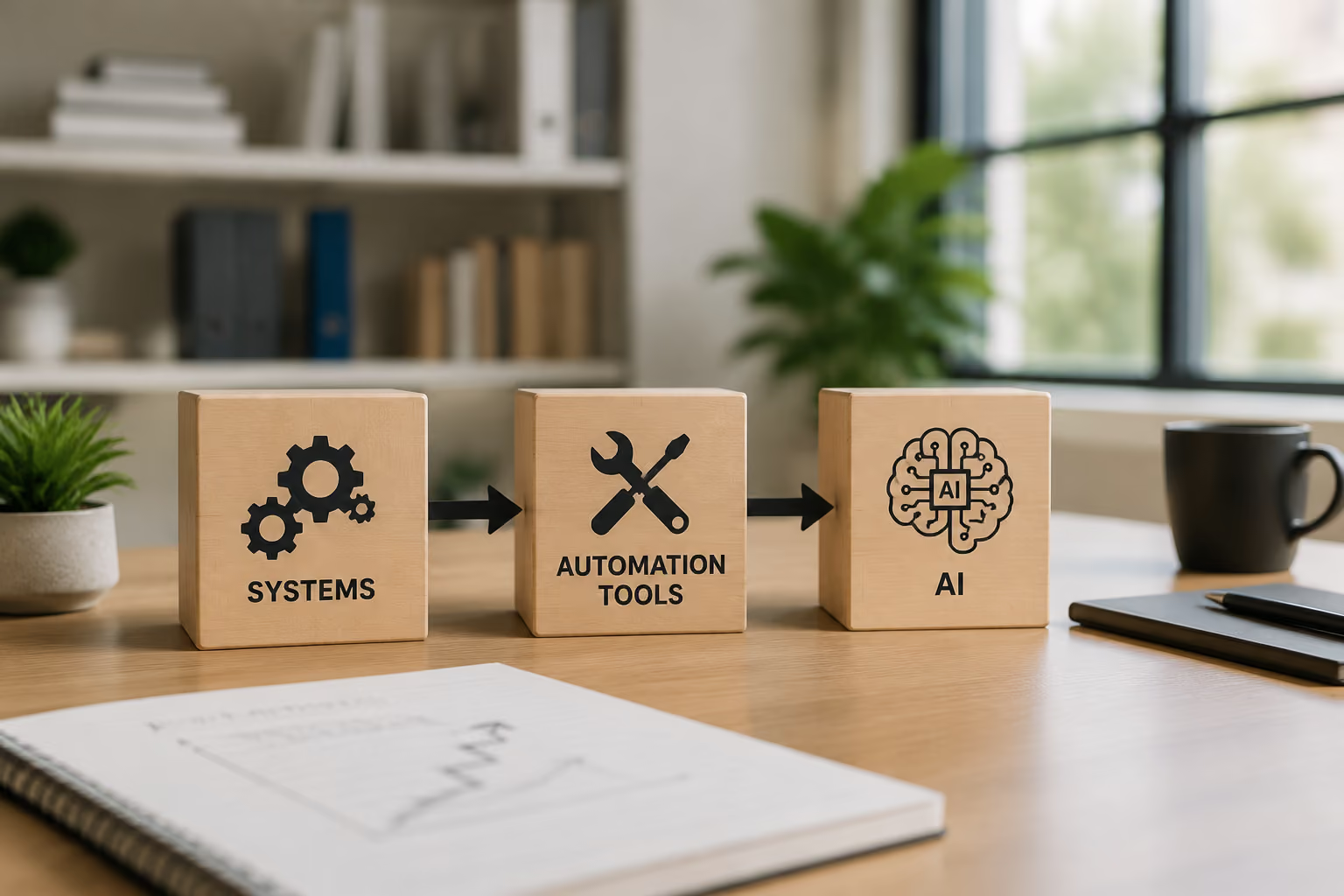
Everything above rests on a sequence that is easy to get wrong.
The operators who automate well are not the ones who automate first. They are the ones who build clear systems first, document the process, and only then decide which parts of that process are safe to hand to a machine; that discipline helps the entire business, not just one workflow. You cannot make good automation decisions about a process you have not defined, because you have no way of knowing which steps carry judgment and which are purely mechanical.
This is why the correct order is always the same: build the system, document it, automate the mechanical parts, and keep humans on the parts that require judgment. Clear systems also support broader business operations and reduce extra effort later when adding new automation. Skip the first steps and you end up either automating chaos or automating the wrong things — usually both. The discipline of knowing what not to automate is really just a downstream benefit of having clear systems in the first place. Without that foundation, every automation decision is a guess. This is the same systems-first logic that helps an organization adapt quickly to change without automating chaos, and that separates a stack you own from a tangle of disconnected tools you are merely renting, especially when you are evaluating online business models best suited for beginners.

Artificial Intelligence can simulate empathy in the real world, but it cannot actually understand a customer's emotional state or take responsibility for the relationship. For routine, low-emotion queries, that is fine. For genuinely upset customers, complaints, and conflicts, the customer needs to feel heard by a person who can exercise judgment. Use AI to draft and route to improve customer experience, but keep a human on the resolution.
It is slightly slower on the specific tasks that need it — and that is the point. The goal is to save time on low-risk work, not to remove humans from every decision. Automation is best for time-consuming work when mistakes are cheap and reversible. The human checkpoint applies only to the small set of high-stakes, high-emotion, or high-judgment tasks. Everything else is automated for speed. The "cost" of a human reviewing refund approvals is far smaller than the cost of an automated system approving fraudulent ones or alienating loyal customers.
You should automate content production but not content identity. Use AI to draft, expand, format, and adapt content within a brand voice and strategy that you define. Do not let AI originate your positioning, point of view, or the editorial judgment about what is worth saying. The voice is the asset; the typing is the commodity.
Run it through five questions: How costly is a mistake? Does it need emotional intelligence? Is it judgment or rules-based? Does it protect or build trust? Does doing it yourself give you irreplaceable signal? If it trips any of the first four or removes signal in the fifth, keep a human involved. If not, automate it fully.
Automating before they have clear systems is one of the biggest mistakes in ecommerce automation. When you automate an undefined process, you cannot tell which steps need human judgment, so you end up either automating chaos or removing humans from exactly the places they were needed; systems must be clear before automation is tailored to business needs. Build and document the system first; then automate the mechanical parts.
The opposite. AI and automation are enormously valuable — for the right tasks. A small store should aggressively automate order status, FAQs, inventory updates, reporting, content drafting, and automated emails. In an online store, automating follow-up for abandoned carts matters because around 70% of carts are abandoned without follow-up. These ecommerce automation flows can recover 20–30% of abandoned-cart sales and, when used well, contribute to a 14.5% increase in sales productivity. The message of this article is not "automate less," it is "automate the right things and protect the few that need a human." That discipline is what makes automation a strength instead of a liability.
The goal of automation was never to remove humans from your business. It was to remove humans from the repetitive, mechanical, low-judgment parts of your business — because the real benefits come when human attention can concentrate on the parts that actually need it.
The operators who understand this build something powerful: a business where machines handle volume and people handle meaning. Orders route themselves while a human handles the upset customer. Reports generate automatically while a human interprets what they mean. Content drafts itself while a human guards the voice. Automation has clear benefits for routine work, but over-automation can widen the gap between management and staff. That is not under-automation. That is automation applied with judgment.
The tasks you should never fully automate — emotional support, financial approvals, brand identity, strategy, quality control, and key relationships — are not weaknesses in your system. They are where your business earns trust, builds loyalty, and stays human in a market full of brands that forgot to. Protecting them is not a limit on your growth. It is what makes your growth worth having. More than 70% of employees find purpose in their work, even as teams waste 40 million hours each month on HR-related tasks that are better candidates for automation than judgment-heavy work.
If you want to learn how to build systems that automate the right things in the right order — and how to tell the difference — that is exactly what the Webgru Academy and the E‑Commerce & AI Academy for building, scaling, and automating online businesses are built to teach. They also map directly onto the e-commerce skills for 2026 that pay, from AI to analytics and the criteria in the guide on how to choose the best e-commerce course in 2026, which both emphasize system-first thinking over shortcuts; the E‑Commerce & AI Academy training path is designed around those same principles. And if you are already operating at scale and want help designing automation that strengthens your business instead of hollowing it out, the Webgru AI Automation approach starts with systems and judgment, not just tools; you can explore next steps through contacting the Webgru team directly or by using the main contact Webgru page to get in touch.
Learn E-Commerce. Build Systems. Then Add AI — and know exactly where to keep the human.
Our latest news and trending topics
Learn E-Commerce with clarity, discipline and real experience.


.png)
.avif)