April 17, 2026
The 5 Core Ecommerce Systems Every Business Needs Before Scaling
Discover the 5 core systems every e-commerce business needs before scaling: traffic, conversion, retention, operations, and analytics.


Scaling an e-commerce business sounds exciting.
More traffic. More orders. More team members. More revenue.
But in reality, most e-commerce businesses do not fail because they lack ambition. They fail because they try to scale before they have the right systems in place.
At first, it often works. A founder can hold everything together manually. Orders are manageable. Customer support can be handled inside inboxes. Marketing decisions are made on instinct. Reporting lives in spreadsheets. Operations depend on a few people who “just know how things work.”
Then growth starts.
And that is where the cracks begin to show.
Traffic increases, but conversion stays weak. Orders go up, but fulfillment gets messy. More customers come in, but retention is poor. More tools are added, but nobody has a clear overview of what is actually working. The business becomes busier, but not better.
This is the point where many founders assume they need more tools, more apps, or more people.
Usually, they need something else first:
systems.
A scalable e-commerce business is not just a store with products and ads. It is a set of connected systems that work together.
If one system is missing, the entire business becomes unstable.
In this guide, you will learn the five core systems every e-commerce business needs before scaling, and how they fit into broader online business models for beginners:
These are the systems that create clarity, reduce chaos, and allow growth without breaking the business.
If you want sustainable growth, this is where you start. Sustainable growth in ecommerce systems means scaling your revenue and customer base efficiently—focusing on operational improvements and attracting the right customers—without drastically increasing costs.
Most founders think scaling problems begin when they get “too big.”
The truth is the opposite.
Scaling problems usually begin much earlier — when a business starts growing on top of weak foundations.
At the beginning, manual work hides structural weakness.
A founder can answer support tickets personally. They can monitor orders one by one. They can write emails manually. They can make marketing decisions based on instinct. They can “patch” broken processes with effort.
That works at low volume.
But growth exposes every weakness. Overwhelmed customer support is a common symptom, as increased demand can quickly surpass the current support capacity, leading to delays and reduced customer satisfaction.
What used to be manageable becomes expensive.
What used to be flexible becomes inconsistent.
What used to feel fast becomes chaotic.
This is why scaling magnifies both strengths and weaknesses.
If your systems are clear, scaling creates leverage.
If your systems are weak, scaling creates stress.
Many businesses think they have a traffic problem when they actually have a conversion problem. Others think they need more marketing when the real issue is retention. Some keep adding tools because they believe tech will solve the problem, when the real issue is lack of process ownership.
Scaling is not just about getting more customers. It is about following a clear, step-by-step roadmap from setup to your first meaningful revenue milestones, like the structured 90-day ecommerce roadmap to your first $10K online.
It is about building a business that can absorb more demand without becoming fragile.
That only happens when systems come first.
The word “system” is often used loosely.
In this context, a system is not just software.
A system is a repeatable structure that takes an input, moves it through a defined process, and produces a consistent output. In e-commerce, systems are specifically designed to streamline and orchestrate business processes, ensuring that interconnected workflows operate efficiently and effectively.
That means a real system has:
For example:
A traffic system is not “we post on Instagram and run some ads.”
A traffic system means:
The same applies to every area of the business.
A support inbox is not a customer support system.
A spreadsheet is not an analytics system.
A checkout page is not a conversion system.
Tools are part of systems, but they are not the system itself.
This distinction matters because many e-commerce businesses keep buying software when what they really need is structure.
If you define the system first, the right tools become obvious.
If you choose tools first, you usually end up in tool chaos.
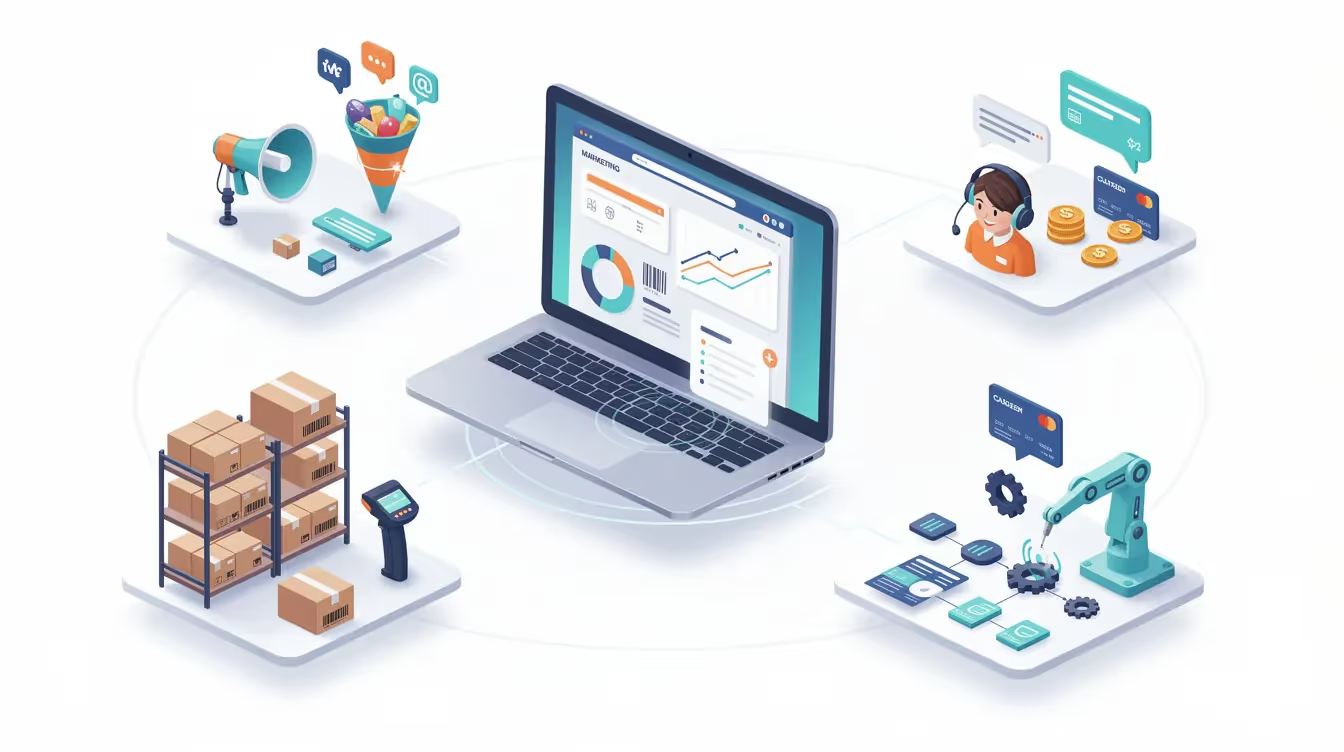
The five systems below are not optional extras.
They are the ecommerce systems that form the foundation for scaling a successful e-commerce business.
Without them, growth creates friction.
With them, growth becomes manageable.
You cannot scale what you cannot feed.
Every e-commerce business needs a clear traffic system before it thinks seriously about scaling.
A traffic system is the structure that consistently brings qualified attention into the business.
That traffic can come from:
The specific channel matters less than the system behind it.
The goal of the traffic system is to ensure your marketing efforts are effectively attracting potential customers and guiding them into your sales funnel.
Ecommerce enables sales to occur anytime, breaking geographical and time-zone limitations.
A functioning traffic system answers these questions:
Many businesses rely too heavily on one source of traffic.
For example:
That is not a traffic system.
That is channel dependency.
A scalable business needs a more resilient structure.
If you try to scale without a clear traffic system, you end up doing one of two things:
One valuable predictable acquisition channel is online marketplaces, such as Amazon or eBay, which can provide consistent traffic and help reach new customer segments.
The goal is not just more visitors.
The goal is more qualified demand.
That means your traffic system should be built around:
The most common mistakes are:
A real traffic system is not about noise.
It is about relevant, repeatable inflow.
Traffic alone does not create revenue.
A business can drive thousands of visitors and still struggle if conversion is weak.
This is why every e-commerce business needs a well-structured ecommerce website and a conversion system before scaling.
A conversion system is the structure that turns attention into action. Ecommerce systems provide essential tools to build and manage online stores, including product management, secure payment gateways, inventory tracking, and shipping integrations.
That includes:
A conversion system should make the buying decision easier.
That means it needs to answer:
In many stores, conversion problems are treated as isolated design issues.
But low conversion is rarely just a button color problem.
It usually comes from deeper issues such as:
Many stores have product pages.
Fewer stores have a conversion system.
A conversion system means:
In other words, the store is not just “there.”
It is built to convert.
If conversion is weak, scaling traffic only makes inefficiency more expensive.
For example:
Implementing competitive pricing strategies—using dynamic pricing and automated market analysis to adjust prices—can significantly improve conversion rates and protect profit margins.
The better your conversion system, the more leverage you get from every acquisition effort.
This is why strong businesses often grow faster not because they have more traffic, but because they convert more of the traffic they already have, supported by core ecommerce skills across CRO, analytics, and automation.
Many e-commerce businesses act as if growth starts and ends with acquisition.
That is one of the biggest reasons they stay fragile.
A business that depends only on new customer acquisition is constantly under pressure.
A business with a retention system focused on customer retention becomes more stable, more profitable, and easier to scale. Acquiring a new customer costs five to seven times more than retaining an existing one, making customer retention a critical part of scaling.
A retention system is the structure that increases repeat purchases, reactivation, and customer lifetime value.
It includes:
Retention changes the economics of the business.
If customers buy again, several things improve:
This matters even more in markets where paid traffic is volatile and margins are under pressure.
A retention system does not mean “we send newsletters sometimes.”
It means you know:
Retention should not be left to chance.
It should be designed.
The biggest mistakes are:
A real retention system creates continuity.
And continuity is what makes scaling sustainable.
This is the system many founders ignore until it becomes painful.
Ecommerce operations encompass the inner workings required to sell products online, including supply chain management, inventory distribution, and order fulfillment. Operations decide whether growth is profitable or chaotic.
An operations system covers the behind-the-scenes mechanics of the business's operations:
Effective inventory management and real-time inventory tracking are crucial for ecommerce operations to meet demand, prevent stockouts, and avoid overstocking. Optimizing shipping costs and ensuring reliable shipping are key to operational efficiency and customer satisfaction.
A business can look successful from the outside while losing money through operational inefficiency.
For example:
Manual, time consuming tasks—like order processing and inventory management—can drain resources and reduce profitability if not automated or streamlined.
Operations are where scale either holds or breaks.
A strong operations system usually includes:
The goal is not complexity.
The goal is reliability.
A founder can manually compensate for weak operations at low volume.
At higher volume, that stops working.
Then the business becomes vulnerable to:
Implementing scalable solutions is essential to efficiently handle growth, allowing ecommerce systems to manage increased order volume and complexity without a proportional rise in costs or staffing.
Growth without operational systems creates internal friction that customers feel very quickly.
That is why operations are not a back-office concern.
They are a growth requirement.
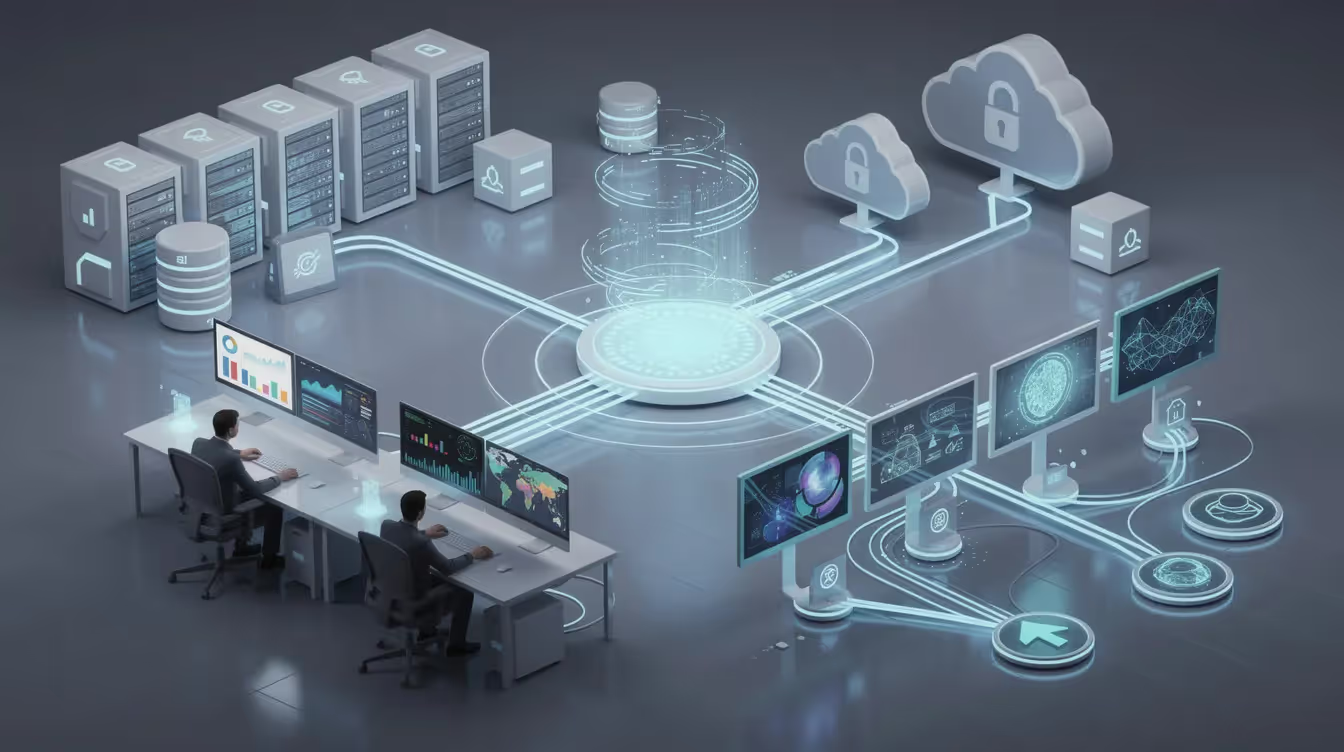
Many e-commerce businesses have data.
Far fewer have a decision system.
An analytics and decision system is what turns numbers into clarity by tracking key metrics and analyzing customer data and customer behavior. These systems help businesses understand how customers interact with their store, from purchase history to abandoned carts, enabling informed decisions and targeted marketing efforts. Ecommerce systems manage everything from product display to final delivery, acting as the digital equivalent of physical retail infrastructure.
It should help the business answer:
Without this system, the business runs on opinions, not decisions.
A usable analytics and decision system does not need to be complicated.
It should focus on the metrics that actually matter.
For most e-commerce businesses, that includes:
The goal is not to measure everything.
The goal is to measure what supports action.
Scaling creates more variables.
More channels. More orders. More products. More customers. More moving parts.
Without a clear decision system, leadership starts reacting emotionally:
That is not scaling.
That is noise.
A real analytics and decision system prevents panic and improves prioritization. By enabling strategic planning and prioritization, decision systems are essential for achieving long-term success in ecommerce systems.
The biggest mistakes are:
A scaling business does not just need data.
It needs operational clarity around decisions.
The biggest mistake is to treat these systems as separate silos.
They are connected.
Traffic drives visitors into the business. Conversion turns them into customers. Retention increases value over time. Operations deliver the promise and serve as the backbone of ecommerce operations, connecting and coordinating supply chain, order fulfillment, and technology integration. Analytics help the business improve all four.
If one system is weak, the others carry unnecessary stress.
For example:
This is why e-commerce businesses do not scale well by optimizing only one area in isolation.
They scale when these systems reinforce each other.
Not every business should build all five systems at the same depth at once.
But the order matters. Sequencing ecommerce systems properly is essential for sustainable business growth, as it ensures each stage supports expansion and scalability.
A practical sequence looks like this:
Before anything else, the business must be able to attract demand and convert it. Marketing campaigns are a foundational element in this process, as they help promote personalized email marketing, automate promotional messages, and integrate these efforts into overall e-commerce automation strategies to enhance customer engagement and drive sales.
Once customers are coming in, the next step is improving lifetime value and reducing dependency on constant acquisition. A systematic approach to customer engagement is crucial for nurturing relationships, enhancing the customer experience, and increasing retention rates.
As order flow increases, operations and support become critical. Automating repetitive tasks within ecommerce systems can significantly improve efficiency, reduce manual effort, and free up staff to focus on more strategic activities.
Analytics should exist early, but decision systems become especially important as complexity grows.
The exact order may vary slightly by business model, but the principle remains the same:
scale follows systems.

This is where many businesses get distracted.
AI is valuable.
Automation is powerful.
But neither should come first.
AI is not one of the five core systems, but it can dramatically enhance them when used to build AI-driven ecommerce automation systems.
It is a layer that can improve them.
For example:
That is the right order.
System first. Automation second.
If you add AI before you have process clarity, you usually automate confusion.
That is why businesses should first understand what their systems are meant to do.
Then they can use AI to strengthen them.
Many founders ask, “When should I scale?” Others are still deciding whether to start with ecommerce or a different digital model, which makes understanding ecommerce vs digital products as a starting point equally important.
A better question is, “What signs show that I am not ready?”
Common signs include:
If several of these are true, the business probably does not need scaling yet.
It needs systems.
A simple internal audit can reveal a lot and pairs well with choosing the best ecommerce course to support your learning path.
Ask these questions:
Is your current ecommerce software providing the advanced functionality, customization options, and scalability your business requires?
Do we know our main acquisition channels and how they perform?
Can we clearly explain why customers buy — or do not buy?
What happens after the first purchase, and is it intentional?
Can the business run smoothly if order volume doubles next month?
Do we have a weekly rhythm for reviewing the metrics that actually matter?
If the answers are unclear, the systems are likely underdeveloped.
That is not a failure.
It is simply the next layer of work.
One reason this topic fits webgru.com so well is that many beginners and early operators make the same mistake:
They think the next breakthrough comes from a new tactic.
But real progress usually comes from better structure.
That is also the logic behind Webgru’s positioning as an ecommerce and AI academy for building and automating online businesses.
The site is built around learning e-commerce, building real systems, and then adding AI, not around random hacks or flashy tactics. The Academy page emphasizes practical courses, automation, scaling, real strategies, and a structured path for both beginners and more advanced sellers. The AI Automation page frames automation as workflow improvement, not magic.
Building effective ecommerce systems is crucial for growing an online business, as it enables sustainable scaling and operational efficiency.
This article sits exactly in that logic.
It gives beginners the operating framework they need, and it gives growing operators a diagnostic lens for why scaling often feels harder than expected.
Many e-commerce programs focus on tools, trends, or tactics in isolation.
The stronger approach is to teach the business as a system.
That is what makes this topic commercially useful, not just educational.
Webgru Academy is positioned around practical e-commerce courses and AI training, including Shopify, automation, scaling, and real strategies. The broader brand language across the homepage and topic pages consistently emphasizes clear systems, discipline, practical execution, and no hype.
This approach directly benefits any ecommerce company looking to scale, providing actionable frameworks that support sustainable growth.
That means the real promise is not:
“Here are some tools.”
The real promise is:
“Here is how to build a business that can grow without collapsing into chaos.”
That is exactly what these five systems represent.
If a beginner understands them early, they avoid years of confusion.
If an existing operator fixes them now, scaling becomes much easier, and it may be the right moment to get in touch with the Webgru team for more structured support.
There is no single most important one. However, a robust e commerce platform is foundational to all core systems, as it integrates inventory management, customer data, and other essential functions within a unified online sales environment. For most businesses, traffic and conversion are the first priority because they determine whether demand can be turned into revenue.
Only for a while. Without retention, operations, and analytics, growth becomes inefficient and unstable. Additionally, offering flexible payment options like Apple Pay can support scaling by improving the checkout experience, making it easier for customers to complete purchases and boosting conversion rates.
No. You need clarity first. While advanced software solutions can help manage ecommerce systems, simple tools with clear structure often outperform complicated stacks with no ownership.
After the underlying process is clear. AI should strengthen systems, not replace basic business thinking. Implementing automation and AI effectively also requires technical expertise, as skilled developers or specialized support teams are essential to ensure these technologies are integrated and maintained properly within ecommerce systems.
That is exactly when system work matters most. Sales can hide structural weakness for a while, but scaling will expose it—and a lack of systems can negatively impact customer satisfaction, even if sales are strong.
If you want to scale an e-commerce business, stop asking only how to get more traffic, more orders, or more tools.
Start by asking a better question:
Which systems are strong — and which ones are still fragile?
Because before scaling becomes a marketing challenge, it is a systems challenge.
The businesses that grow cleanly are not always the loudest.
They are usually the ones with:
That is what makes growth sustainable.
Not hype. Not hustle. Not more apps.
Systems.

If you want to build a real ecommerce store and not just patch together random tactics, start with the foundation.
Inside Webgru Academy, you learn how to build the ecommerce systems behind traffic, conversion, retention, operations, and AI-powered growth — in the right order.
Start learning with Webgru Academy
Our latest news and trending topics
Learn E-Commerce with clarity, discipline and real experience.